ZapaShiva

June 13, 2011

ZapaShiva

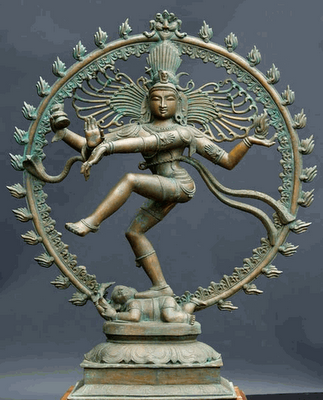
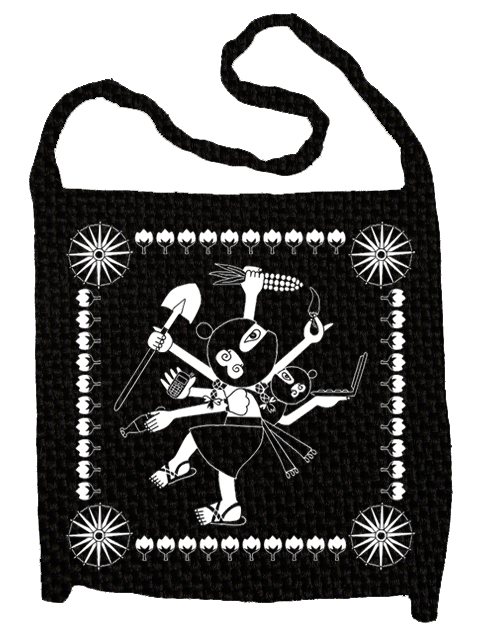
The image above is of ZapaShiva, a Zapatista woman in the Shiva pose. I made the image for the 5year Plan which was started by my friend Aaron Sinift, an artist, activist and entrepreneur in Brooklyn NY.

The first project that Aaron curated and brought to life was an artist book featuring the work of 26 artists. I made an image for the book. You can check it out in this earlier post. The images were printed on cotton khadi. The cotton was spun by artisans in India. The idea behind the book is to make a sustainable art piece and to celebrate the Gandhian ideals of self sufficeincy and non violence.

This video explains the project really well. 

In both images I’ve made for the 5year plan I tried to make a link between social movements in India and in Mexico. I am not an expert on the Zapatistas, but their struggle for self-governing and their resistance to transnational corporations resonated for this project.

The woman is holding a shovel and an ear of corn to symbolize the struggle for autonomy . She has a cell phone and a laptop, because the internet was a fundamental tool for the Zaptistas and it has proven to be a fundamental too for any social movements to come.

She is emptying a Coca-Cola bottle to simbolize the resistance against transnational corporations and she is holding a chilli because when I think of Mexico and India I think of food, spicy food. The cotton bolls and the wheels that frame the image are there to represent the fact the image will be printed on hand spun cotton khadi.

ZapaJhola mock-up

Now Aaron is working on jhola bags. His approach with them is twofold. He plans on printing some limited edition jhola bags with original artwork featured on them.

But he is also looking to work with large retailers to offer jhola bags at their store for shopping. The jhola bag is the anti plastic bag. There are no carbon emissions involved in its production because it is made by hand and it helps some of the poorest people in India and the world to support themselves.

t-shirts

June 13, 2011

ZapaShiva tee

I have been making some t-shirt mock ups lately. The one above is of ZapaShiva, a Zapatista woman in the pose of the Hindu godess Shiva. I’ll write about the image on my next post.

This is another mock up I made.

Original Baller

I am thinking of submitting my designs to Threadless. An online store and community where you submit your design and people vote for it. If people vote for your design Threadless considers printing the tee and selling it. The designer/artist gets a cash prize.

M train, West 4 to Marcy Ave

This one has one of my subway sketches on it. I made it on the M train from the West 4th Street stop to the Marcy Avenue stop. To see more of my subway sketches click here. Any thoughts or suggestions on these tees? If I print them, would you buy one?

Diego Rivera is out and about

June 10, 2011

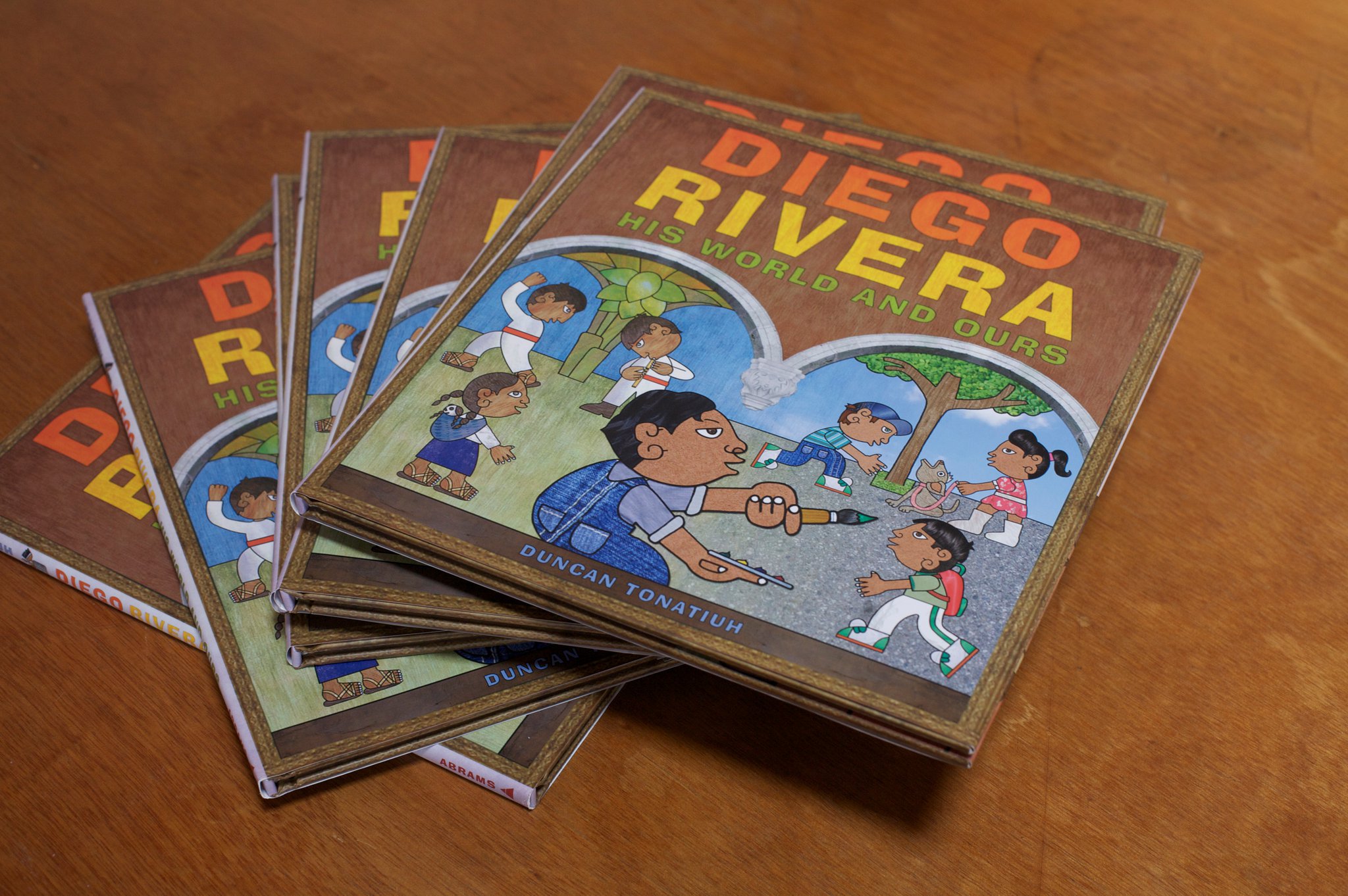
Diego Rivera: His World and Ours

I have not posted a new entry to my blog in several months. I apologize for that. I have been quite busy and productive though. My second picture book Diego Rivera: His World and Ours was published by Abrams this last May.  You can buy it online from Abrams or from Amazon among other retailers.

The book has received some great reviews so far.

It received a Parent’s Choice Recommended Seal by the spring 2011 Parents’ Choice Book Awards.

The Latin Baby Book Club chose Diego Rivera:His World and Ours as their June book of the month. They did a Q & A with me too.

The Happy Nappy Bookseller gave the book a very generous review. “There are a few children’s biographies about Diego Rivera. Tonatiuh’s sophomore release is a great addition, with it’s own personal distinctions. ”

It got a starred review from Kirkus. “A simple picture-book biography of Diego Rivera concentrates on his artistic career and encourages children to imagine themselves painting their own world… Both solid introduction and exhortation, this book will thrill budding artists.”

And Publisher’s Weekly gave it a great review “Suggestive of stained glass windows, Tonatiuh’s mixed-media collages combine ancient Mexican art motifs with blocky, stylized figures, to pay tribute to this versatile artist.”

I am heading to Dallas later today. I am thrilled to be a part of the 1st Annual BooksmART Festival in the Dallas Museum of Art where I will read Diego Rivera: His World and Ours and also Dear Primo, a letter to my cousin.

I will be visiting 3rd graders at the The School at Columbia University next Monday and I will be heading to New Orleans at the end of the month for the ALA conference. I have a busy and exciting month ahead.

Machete

November 6, 2010

Danny Trejo: Machete, Machete, Machete


I would love to make animations for the initial credits of films… Experiments TK soon.


Dope, catchy song by Novalima that is featured in the Machete soundtrack.


Diego Rivera: His World and Ours

October 12, 2010

page 3

This is a sneak peek at my upcoming picturebook “Diego Rivera: His World and Ours” I am the author and illustrator of it. It is going to be published by Abrams and will be available next spring.

page 9

The first part of the book is a biography of the great muralist.

But then the book asks what would Diego paint today? For instance, “Would he paint our craze for monsters and creatures of outer space as he painted the god Quetzalcoatl and the feathered serpent?”

page 30-31

What I admire the most about Rivera is that he looked back at the art of ancient Mexico and combined it with the art of the modern era.

p16-17

In my work I attempt to do something similar. I look back to that ancient art also, but I try to combine it with the tools of the digital era.

NIOSH

October 12, 2010

These are a series of illustrations I did for NIOSH, the National Institute for Occupational Safety and Health. They will be displayed in brochures at the Mexican Consulate to inform immigrants about safety measures in the work place.

In the first illustration I tried showing a hardworking immigrant family looking for a better future. I tried flipping this border sign image.


border sign


The second one is about the risks of injuries while working in jobs such as construction when the adequate safety measures are not provided.


roofer, rufero


The third one is about the dangers of toxic chemicals in the workplace.


cleaning lady


Tbilisi

May 18, 2010

Duncan

One of the most exciting experiences I’ve had this year was attending the Tbilisi Regional Art Festival -Degree & Profession in Tbilisi, Georgia. I was invited to present my project Journey of a Mixteco, which was my senior thesis at Parsons the New School of Design in 2008.

I went to the festival with Lydia Matthews, Dean of Academic Programs at Parsons and three other Parson’s alumni: Christopher Nesbit from Photography, Ida Benedetto from Design and Technology and Georgeana Ortiz from Fashion. It was Lydia’s sixth time in Tbilisi. Besides her work at Parsons she is a curator and has brought artists to the city before. We were the only American university invited to the event. This invitation was largely due to the relationship and passion that Lydia has with the Georgian country.

Several European universities were invited to participate. Unfortunately due to the volcanic ash, only Parsons and the Yerevan State University of Architecture and Construction from Armenia were able to attend. The event was hosted by the Tbilisi State Academy of Arts, but several schools from Tbilisi were involved. The Romualdo del Bianco Foundation was an instrumental sponsor of the event.

Most of our Parsons group flew from JFK. Some of us met for the first time at the airport. Ida, who is a Fulbright grantee in Ethiopia, flew from Addis Ababa to meet us.

Hagia Sophia

We were able to work out a day stop in Istanbul before heading to Tbilisi. Istanbul is an incredible city, and it was a tease to be there for such a short time. Click here to see more photographs I took while in Istanbul.

***

The Tbilisi festival organizers were incredible hosts, especially Nana Iashvili the Dean of the Faculty of Art Media, who always looked after us. Plenty of food and wine were a must every day. During our visit we attended a variety of cultural events and were able to go sightseeing in the country on two occasions.

We visited Mtskheta, Bodbe and Sighnaghi.

near the Jvari monastery

I was really taken aback by the churches. They are very sparse, like caves and have wonderful Byzantine art. Being in such ancient places makes one realize how old the world is.

This is a link to more photographs

***

Shibori

We we were in Tbilisi for 4 days total. On the second day Georgeana and I participated in a Shibori workshop. Shibori is a Japanese dying technique. The workshop was held at La Maison Bleue, a textile art studio established by five artists, all graduates of the Tbilisi State Academy of Art. The workshop instructor was Keti Kavtaradze. I got to meet her and Nino Kvrivishvili, also an artist at the studio.

Nino Kvrivishvili

The students that participated were from a variety of universities and from different disciplines, but mostly from textile design. These are the pieces that Georgeana and I produced.

Click here to see more photographs of the workshop.

***

Presentation Day

On the last day of the festival we did the presentations of our thesis. Ida presented Lilliput, a photographic non-linear travel log. Chris showed his drawings of vanished buildings in New York imposed over photographs and videos of what stands there now. Georgeana showed a sustainable fashion collection inspired by the atmosphere and a best practice manual for sustainable fashion designers. I presented Journey of a Mixteco, a short graphic novel based on the true story of an undocumented Mexican worker that now lives in New York.

when I come to New York I have so many jobs, man

There were a number of Georgian students that that also presented their thesis, as did two of the Armenian students. Most of the other projects shown were in the fields of architecture and animation.

After the thesis presentations there was a break. Afterwards there was a presentation of the projects that were produced during the workshops. In most of the workshops a variety of students came together for a couple of days and put together a short presentation that addressed a topic. Many of them had to do with globalization, and many were a celebration of  Georgian culture and heritage.

A fashion show followed, and afterward there was a ceremony to announce award winners.

Christopher won the award for the best design. And to my delight my project won the prize for the best presentation. I was thrilled. It is very encouraging to know that although my project is very specific to an area in the world it is able to transcend and to be appreciated and understood in a completely different part of the world. I really want to continue developing the project now. I am looking for grants. Suggestions for places to look into are very welcome.

Chris, me and the xinkhali

It was a very special trip for me. I was able to connect with my Parsons peers through out the week and I was able to connect with some of the Georgian staff, faculty and students. They were very glad I won the award and that made the experience that much more memorable.

Georgians can and love to sing

I know the Festival was being filmed for a program on Georgian TV. I would love to get a hold of that footage.  It’d be very amusing to watch. I’m also looking for a youtube link to Mexican soap operas in Georgian. I saw a clip on TV for one of them at the hot baths…

***

The flight back to New York was brutal.

at the Istanbul airport

Author’s Day at the Woodbridge Library

May 17, 2010

Mixteco codex

My first book event in the US was at the Woodbridge Library in New Jersey. Every year the library has an Author’s Day when they invite several writers and librarians from the region to come. The librarians get to see the writers’ new work. We all get to meet each other and new books are brought back to libraries.

The event went really well. I did a presentation of my book Dear Primo. The librarians there specially liked the artwork of the book and where able to further appreciate it because I showed some slides of the Pre-Columbian and Mixteco art that inspires my illustrations. The copies of my book at the event sold out, and I signed a lot of books. It was very rewarding.

The Popularity Papers

There were other authors at the event. I specially liked meeting Amy Ignatow. She is a fellow author-illustrator. Her book is called The Popularity Papers. It’s super-entertaining and I highly recommend it. It’s published by Abrams also.

The only dark side to the visit was that I learned from librarians in Woodbridge that up to 70% of the New Jersey public library budgets are being cut. Unfortunately this is the case in many other states. You can visit http://www.ilovelibraries.org/ to get involved and sign a petition to stop these cuts.

I have some new events coming up. I will be at the Book Expo in the Javit Center in New York City on May 25th. I will be at Books of Wonder in Manhattan on June 5th and I will be at the American Library Association conference in DC on June 27th and 28th. I’ll put more info about these events in my facebook and twitter accounts as the dates approach.

Uninter Cuernavaca

May 17, 2010

Rivera mural in the Cortez Palace, Cuernavaca

I was invited by Abraham Popoca to show my book at the Universidad Internacional in Cuernavaca. Abraham along with a group of students there runs a research center that looks into policy relating to children’s rights. They were interested in my book because of its bi-national nature.

I did a presentation of the book and showed them also another picture book I wrote and illustrated called Solar Cookies. The college students there enjoyed the books and had excellent and challenging questions. One of the students asked me if I worried that the Mexican child in the book was a stereotype, or that a Mexican child who saw the book would be ashamed of how Mexican children are represented in it.

Dear Primo’s main character are Carlitos and Charlie. Carlitos is a rural boy from Mexico, Charlie is his cousin and lives in a city in the US. Carlitos wears sandals. Charlie wears hightop sneakers and a fitted baseball hat.

Carlitos

I could understand why the Uninter student would ask that question. I have a multilayered response to it. To begin, the book is addressed to children between 4-8. And though I always attempt to create something sophisticated, for this project it was very important to focus on the contrasts between Carlitos and Charlie -much like the country mouse and city mouse story- and keep them clear and simple.

I am aware that Mexico is a very urbanized country. The Mexico City metropolitan area is the largest metropolitan area in the American continent. And I am aware that Mexico is in many ways a very Americanized country, and that the US also is a very Mexican country. But again, for the sake of clarity and simplicity I had to make the contrasts in food, environment, etc very clear, almost extreme. Yet, the point of the book is that regardless of their nationalities Carlitos and Charlie are at heart more alike than different.

There is an important reason why I decided to make Carlitos a rural boy and Charlie an urban one. Without being overt, I am acknowledging the migration of Mexican workers to the US. A large portion of these workers come from rural backgrounds and often migrate to cities in the US. They work as deliveryman, nannies, construction workers and in other service industries. That is the experience of people I know both in San Miguel Allende, where I grew up, and in New York, where I went to school.

Further, tradition and progress don’t have to be mutually exclusive. One can be can modern and up to date and at the same time have a strong sense of identity. One can be technologically savvy and at the same time be proud of ones heritage and traditions.

After the presentation I got to hang out with some Uninter students. It was a lot of fun. The students at the research center are a very close and supportive group.
***

I’m currently working on a new picture book. It is inspired by the life and art of Diego Rivera. It wil be out next spring. Although I didn’t see the Rivera mural in Cuernavaca on my visit to the Uninter, I did see it on a previous visit to the city. It’s excellent and entrance is free on Sundays, I believe.

Rancho Alcocer School

May 17, 2010

Escuela Rancho Alcocer

It was quite fitting that the first reading of my newly published book Dear Primo was to kids at my old elementary school. It was a spur of the moment kinda thing. I ran into Mario, my old principal, at el Tecolote bookstore. A few days later I grabbed the proof of my book -the book wasn’t available yet then- and took the little school bus up to Alcocer, a rural community outside of San Miguel Allende.

There are only 20 or so students in the school. They don’t wear uniforms. Students from different grades are mixed together. There are chickens, rabbits and a large vegetable garden that the students help rise. The school was closed for many years, but it re-opened two years ago. Fortunately, very little has changed since the time I attended it more than 15 years ago.

It was a very special to be in Alcocer as a guest alumni after such a long time. It was lot of fun and a good learning experience reading to the kids there. They enjoyed the book. They asked a lot of questions and put me on the spot more then once.


Follow

Get every new post delivered to your Inbox.